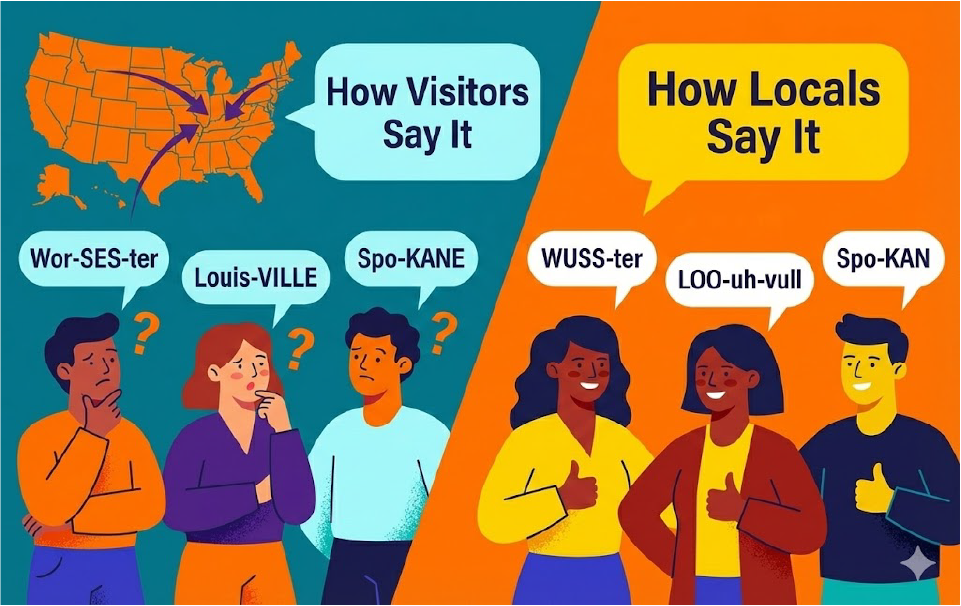
You’re Saying It Wrong (And Everyone Knows)
The sign said “Worcester” but the GPS said “WUSS-ter.” You laughed. Your friend from Boston did not.
“That’s how everyone says it,” they told you, dead serious. You stared at the sign again, counting letters. Six letters. Two syllables. It made no sense.
This is the moment when a place name stops being a word and becomes a test. You either sound like you belong, or you sound like you just got off the highway.
The Road Trip Moment
Picture this: You’re driving through a small town, reading street signs out loud. You see a name that looks straightforward, so you say it the way it’s spelled. Someone in the car—maybe a local, maybe someone who’s been there before—stops you mid-word.
“No, it’s pronounced…”
You pause. You look at the sign. You look back at them. The spelling and the sound do not match. At all.
Example: This happens everywhere:
- In Massachusetts, “Worcester” becomes “WUSS-ter”
- In Kentucky, “Louisville” becomes “LOO-uh-vull”
- In Louisiana, “New Orleans” becomes “New OR-lins”
The letters are there, but locals have decided to ignore half of them.
The first time you hear it, it sounds wrong. It sounds like someone is making it up. But then you realize: everyone around you is saying it the same way. The visitor is the one who sounds wrong.
When Even Locals Disagree
Here’s where it gets interesting. Sometimes, even locals argue about pronunciation. You’ll hear two people from the same town insist on different ways to say the same word. One person pulls up a dictionary. Another pulls up a video of a local news anchor. Someone else mentions their grandmother’s way of saying it.
Key idea: The debate settles nothing, because pronunciation is not about being right. It’s about belonging.
When you learn how locals say a place name, you’re not just learning a sound. You’re learning a piece of local identity. You’re learning what that place calls itself, not what outsiders call it. The pronunciation carries history, migration patterns, and everyday speech that has nothing to do with spelling rules.
Why It Matters
Getting pronunciation right is not about perfection. It’s about respect. When you take the time to learn how locals say their own place names, you’re acknowledging that the place has its own identity, its own way of speaking, its own history.
You’re also avoiding the moment when someone has to correct you—the awkward pause, the gentle correction, the subtle shift in how they see you. You go from being a visitor to being someone who paid attention.
💡 Quick takeaway: The next time you see a place name that looks simple, remember: the spelling might be lying. Listen to how locals say it. Ask if you’re not sure. And when you hear two locals arguing about the “right” way to say it, remember that both of them are right—because pronunciation is about belonging, not rules.
Explore pronunciations by state:
- Massachusetts pronunciations (Worcester)
- Kentucky pronunciations (Louisville)
- Louisiana pronunciations (New Orleans)