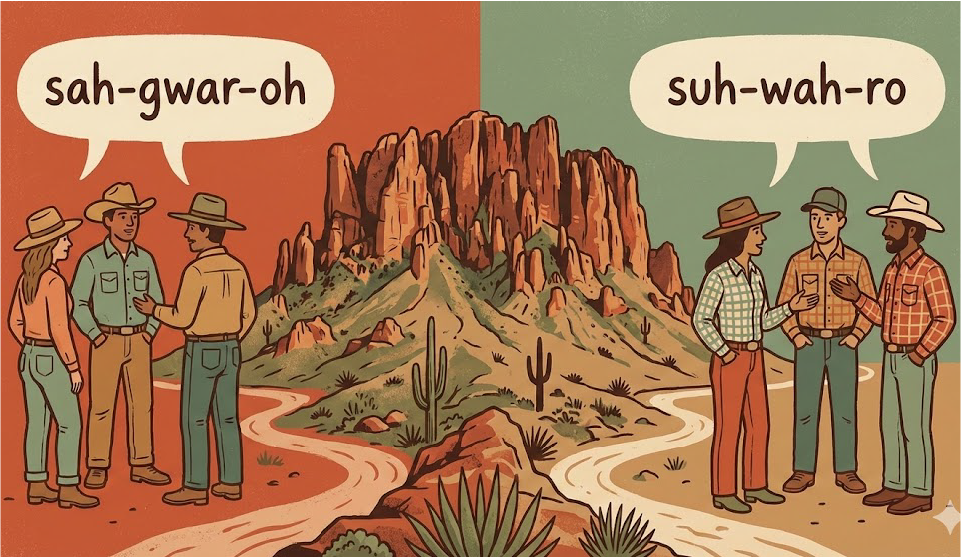
Same Word, Different Town, Different Sound
Two people who both live there are talking casually when the word comes up. It is a normal word. A place name everyone recognizes. One person says it without thinking. The other pauses, then repeats it back a different way.
They look at each other, slightly confused. Not offended. Just certain.
They both know the word. They have both lived there for years. Neither one is joking. Neither one feels unsure. Each version sounds completely normal to the person saying it and completely off to the person hearing it.
For a moment, it feels like one of them must be wrong. Then the stranger realization sets in. They are both local. They just learned the word in different places, from different people, at different times.
It is a disagreement that should not exist, but it does. And once you notice it, you start realizing how often it happens.
Pronunciation Doesn’t Follow Borders
Pronunciation does not follow spelling, and it does not follow borders. We like to believe there is one correct way to say a word and everything else is a deviation. In reality, the sound of a word is shaped long before anyone agrees on how it should look on a map.
Words move with people. They pick up accents, rhythms, and shortcuts along the way. When a group settles somewhere, the way they say things becomes part of the place. That sound gets repeated, reinforced, and passed down until it feels obvious and unquestionable.
State lines do not stop this process. Neither do county lines or city limits. A word can shift over a surprisingly short distance if the communities on either side grew up hearing it differently.
Spelling stays fixed on paper, but pronunciation keeps moving. That is why two people can look at the same word, agree on every letter, and still hear something completely different when it is spoken out loud.
How Geography Shapes Sound
Geography plays a quiet but powerful role in this. Distance, terrain, and isolation shape how often people interact, and that shapes how language spreads. When communities are separated by mountains, deserts, rivers, or long stretches of empty land, their speech has more room to drift.
Even small barriers can matter. A mountain range that makes travel inconvenient. A rural area that keeps communities more self contained. Over time, these separations allow pronunciation to settle in slightly different ways.
People on one side of a natural boundary hear each other every day. People on the other side hear a different version just as often. Each version becomes normal to the people who use it.
The Southwest Example
In the southwestern United States, this is especially clear. Arizona and New Mexico are home to many Native nations whose communities exist relatively close to one another, yet whose languages are entirely different. These are not variations of the same language. They are distinct systems with their own sounds, rhythms, and structures.
Many place names in the region come from these languages. Even when the spelling gets adapted into English, the sound underneath it reflects where it came from and who has been saying it the longest. Different communities interacted with these names in different ways, so multiple pronunciations continue to exist side by side.
This is where pronunciation stops being a technical detail and becomes cultural memory. The sound of a word holds information about who lived there, who spoke it, and how it moved through time. Hearing different versions is not confusion. It is history still being spoken out loud.
Why Multiple Versions Can All Be Right
Multiple pronunciations can all be right because language is not governed by a single authority. It is governed by agreement. When enough people in a place say a word the same way for long enough, that version becomes correct there.
Pronunciation is reinforced socially. You hear it from family, friends, neighbors, and coworkers. You repeat it. Others repeat it back to you. Over time, the sound becomes so familiar that alternatives do not just seem different. They seem wrong.
When two communities develop their own shared versions, neither one is mistaken. Each pronunciation works within its own context. The problem only appears when those contexts overlap and people expect one version to apply everywhere.
Listening for History
Once you start listening for these differences, it changes the way you hear familiar words. What once sounded like inconsistency starts to sound like history. Every variation points back to how people moved, settled, and spoke to one another over time.
The same word can feel perfectly natural in one town and slightly off in the next because the sound belongs to the place that shaped it. Crossing into a new area means stepping into a different set of shared habits, even when the spelling stays the same.
Language in the United States is full of these quiet shifts. They are easy to miss until you hear them side by side. Once you do, it becomes harder to believe there was ever only one way a word was supposed to sound.